Guangzhou Laboratory releases EpiETL, an AI-enabled platform for global infectious-disease epidemic intelligence
Three coordinated AI agents support the aggregation, curation, and use of global epidemic information
On 2 November, the Artificial Intelligence Sub-forum of the 2026 Greater Bay Area Science Forum and the 7th China (Guangdong) Artificial Intelligence Forum were held in Guangzhou. During the session for releasing forum outcomes, Guangzhou Laboratory released EpiETL, an AI-enabled platform for global infectious-disease epidemic intelligence. Yixue Li, head of the Department of Bioinformatics and Artificial Intelligence Research at Guangzhou Laboratory and director of the Greater Bay Area Bioinformatics Center, introduced the platform’s background, technical architecture, and intended uses.

Infectious-disease surveillance information is dispersed across the World Health Organization, national and regional centers for disease control and prevention, and other official health authorities. Reports appear as web pages, PDFs, scanned documents, and tables, and they differ in language, pathogen names, indicator definitions, and statistical criteria, making them difficult to integrate on a continuing basis. Built by the Department of Bioinformatics and Artificial Intelligence Research at Guangzhou Laboratory, EpiETL connects official information collection, data curation, risk-event identification, and intelligence services. It currently covers more than 100 official release channels from 80 health institutions worldwide, including the World Health Organization, the Chinese Center for Disease Control and Prevention, the U.S. Centers for Disease Control and Prevention, and the European Centre for Disease Prevention and Control. The platform continuously synchronizes official surveillance bulletins, with the operational target of making a report available on the day after its release, and retains the original source.
The platform organizes its processing into three agents, for data curation, risk events, and question answering and research. For each source, the data-curation agent applies a reading guide that specifies pathogen names, the meaning of indicators, statistical criteria, and the information to be extracted, and then parses the source text, standardizes names, and checks quality. The risk-event agent uses pathogen, time, and place to link reports issued by different institutions, compare records that may be duplicates, and help identify later updates to the same event. These results are intended to support analysis and do not replace official risk judgements issued by competent health authorities. The question-answering and research agent lets users ask about a pathogen, place, and time range. It retrieves evidence from the curated data and the original reports, brings together information from multiple sources, and marks the official reports cited in each answer.
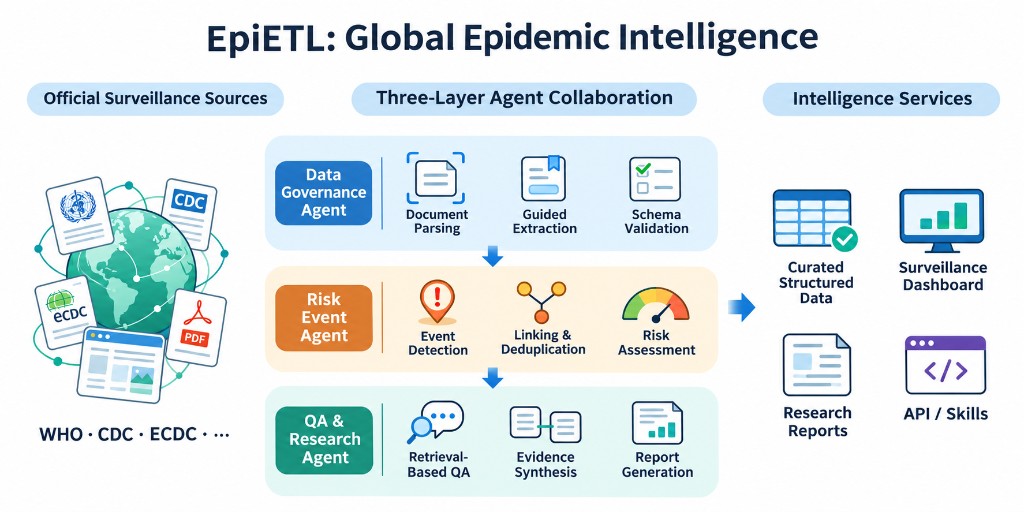
On this basis, EpiETL provides a risk map, a weekly report, and AI question answering, together with structured data and an API for retrieval, verification, and further analysis. The model scores shown on the risk map are intended to help review recent public surveillance information. They do not represent official risk levels issued by health authorities. Registration is open, and information on the platform’s functions, data sources, and API is available at https://epietl.com.